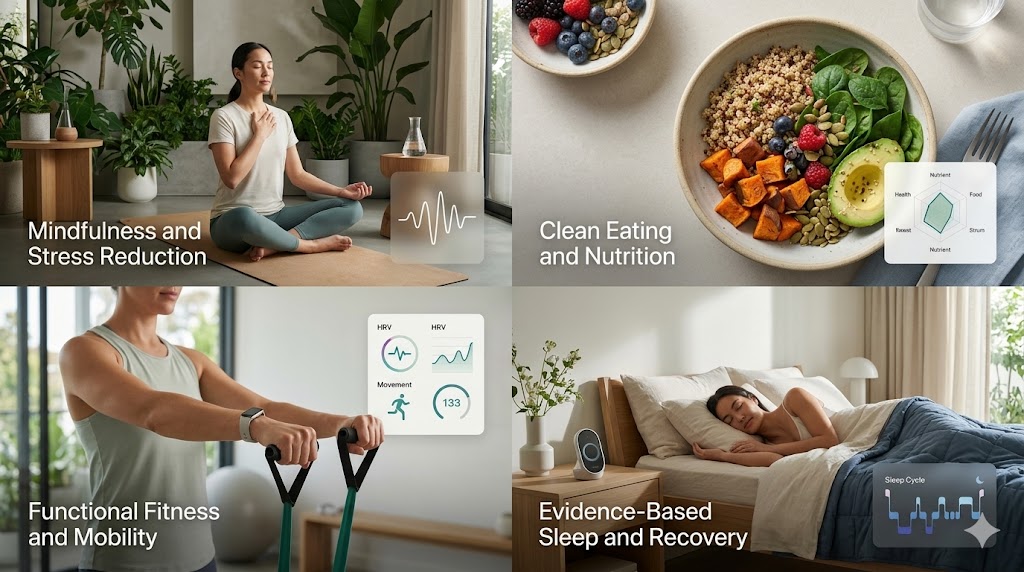
Introduction
Walk through any bookstore, scroll any wellness influencer feed, or browse the supplement aisle at a major retailer and the volume of advice can feel overwhelming. Some of it is useful. Some is recycled folklore dressed up as science. Sorting one from the other is the difference between routines that move the needle and routines that drain time and money.
This article looks at modern wellness trends that hold up under research scrutiny. Each has been studied in peer-reviewed settings and produced consistent enough results to take seriously. The aim is to identify habits that quietly improve daily life when practiced over months and years.
Strength Training for Almost Everyone
For decades, cardio dominated wellness advice. Running, cycling, and aerobics classes were treated as the gold standard. Research over the past fifteen years has rebalanced the picture. Strength training, once seen as the domain of athletes, is now recognized as one of the most protective practices an adult can adopt.
Studies tracking older adults show that two to three sessions of resistance training per week reduce the risk of falls, preserve bone density, and slow the loss of muscle mass that quietly accelerates after age forty. The benefits extend to metabolic health as well, with consistent training improving insulin sensitivity and resting metabolic rate.
Practical Starting Points
You do not need a barbell to begin. Bodyweight squats, push-ups, and resistance band rows performed twice a week produce measurable gains within eight to twelve weeks for most beginners. The key is progressive overload, which means slightly increasing reps, sets, or resistance over time.
Sleep as a Performance Tool
Sleep research has matured rapidly. The American Academy of Sleep Medicine and the CDC both recommend seven or more hours per night for adults, and the data behind that number is substantial. Chronic sleep restriction is associated with higher rates of cardiovascular disease, weight gain, mood disorders, and impaired immune function.
The trend worth adopting is not a specific gadget but the basics done consistently. A regular bedtime, a cool dark room, limited evening alcohol, and a buffer between screens and sleep all show up repeatedly in the research as high-leverage habits. Wearables can help track patterns, but they are most useful as feedback tools, not as anxieties to manage.
Why Caffeine Timing Matters
Caffeine half-life studies show that an afternoon coffee at three still leaves a quarter of the dose active at bedtime. Many adults who feel they sleep poorly find meaningful improvement simply by ending caffeine intake by early afternoon.
Mediterranean and Mediterranean-Style Eating
Few dietary patterns have accumulated as much supporting evidence as the Mediterranean approach. Long-term studies in Spain, Greece, and the United States have linked it to lower rates of heart disease, type 2 diabetes, and certain cognitive declines.
The pattern is not exotic. It emphasizes vegetables, legumes, whole grains, fish, olive oil, nuts, and modest amounts of dairy and poultry, with limited red meat and added sugar. The American adaptation is straightforward. Build meals around plants, use olive oil as the default cooking fat, eat fish twice a week, and treat highly processed snacks as occasional rather than daily.
Walking as a Foundational Habit
While intense exercise gets attention, the research on walking is striking in its breadth. Studies across populations consistently associate daily step counts in the range of seven to ten thousand with lower all-cause mortality. The benefits begin well below ten thousand and continue to climb gradually.
For most Americans whose work involves long hours at a desk, building walking into the day is the single most accessible wellness shift available. A short walk after lunch helps blood sugar regulation. A walking meeting replaces a sedentary call. A morning walk produces consistent mood benefits that match those of a low-dose antidepressant in some clinical comparisons.
Mindfulness and Meditation, Practiced Realistically
Mindfulness can feel like a saturated topic, but the underlying research remains strong. Reviews of randomized trials show modest but consistent reductions in anxiety, depression, and stress markers in adults who practice daily for eight weeks or more. The most studied program, Mindfulness-Based Stress Reduction, has been used in hospitals and corporate wellness programs for decades.
The practical version does not require silence retreats. Ten minutes a day with a guided app such as Calm, Headspace, or Insight Timer, or a simple breathing practice between meetings, captures most of the benefit available to a beginner.
Why Short Sessions Work
Studies suggest that consistency matters more than session length for early benefits. Ten minutes daily outperforms one long weekly session because the nervous system adapts through repetition, not through occasional intensity.
Time Outdoors and Nature Exposure
Researchers in several countries have found that regular time in green spaces is associated with lower stress hormones, improved mood, and better sleep. A widely cited 2019 study suggested that two hours per week in nature was a meaningful threshold for self-reported well-being benefits.
This is welcome news for Americans who do not live near wilderness. A neighborhood park, a tree-lined walk, or a local trail counts. The mechanism is not fully understood, but the consistency across studies makes nature exposure one of the lowest-cost wellness habits available.
Social Connection as Health Infrastructure
The Surgeon General’s 2023 advisory on loneliness highlighted research showing that prolonged social isolation carries health risks comparable to smoking nearly a pack of cigarettes a day. The research community has been clear that human connection is not a soft topic. It is a measurable health input.
The trend worth adopting is intentional connection. A weekly call with a longtime friend, a standing dinner with neighbors, a small group activity, or volunteering in a recurring role all qualify. The effects show up gradually but reliably across decades of cohort data.
Protein Intake That Matches Your Body
Nutrition science has updated its protein recommendations over the past decade. The traditional 0.8 grams per kilogram of body weight is now widely viewed as a minimum for sedentary adults, not an optimum. Newer research, particularly for adults over forty, points to roughly 1.2 to 1.6 grams per kilogram for muscle preservation and metabolic health.
The practical takeaway for most Americans is simple. Include a quality protein source at each meal, such as eggs, Greek yogurt, fish, beans, tofu, or lean poultry. Spreading intake across the day appears to be more effective than packing it into one large dinner.
Sauna and Heat Exposure
Long-term Finnish studies on sauna use have produced unusually strong results, linking regular sauna sessions to lower cardiovascular and all-cause mortality. The likely mechanism is improved vascular function and a heat stress response that mimics some of the effects of moderate exercise.
For Americans, this is increasingly accessible through gym saunas, home infrared units, and community wellness centers. Two to four sessions per week of fifteen to twenty minutes appear to be the range associated with the strongest benefits in observational data.
What to Be Skeptical About
Not every trend earns a place in this list. Cleanses and detoxes lack credible evidence. Most adaptogen blends are weakly supported and inconsistently dosed. Cryotherapy shows mixed results that do not justify its cost for most people. Extreme fasting protocols can offer short-term metabolic benefits but carry adherence and nutrient risks that often outweigh the gains. A useful test is whether a trend has been studied across multiple independent research groups for at least a decade.
Conclusion
The wellness habits with the strongest research support are remarkably ordinary. Move regularly, lift something, eat plants, sleep enough, spend time outside, stay connected to people, and pay attention to your breath. None of it is exciting. All of it works. Choose two or three of these areas to focus on for the next ninety days rather than trying to overhaul everything at once. The professionals who age well into their seventies and eighties almost always describe a similar pattern of small, repeated choices, sustained quietly across decades.
FAQs
How much exercise is actually needed each week?
The federal physical activity guidelines recommend 150 minutes of moderate aerobic activity plus two strength sessions per week, which most research supports as a reasonable minimum for adults.
Are wellness trackers and rings worth the cost?
They can be useful for awareness, especially for sleep and step counts, but they do not produce results on their own. The behavior change matters more than the device.
Is intermittent fasting supported by research?
Short eating windows can help some adults manage calorie intake, but long-term studies show similar results to standard calorie reduction. It is a tool, not a magic protocol.
Do I need supplements if I eat well?
Most healthy adults eating a balanced diet need few supplements beyond possibly vitamin D, omega-3 if fish intake is low, and fiber if intake is consistently below recommended levels.
How do I evaluate new wellness trends I see online?
Look for randomized trials, multiple research groups reaching similar conclusions, and effects observed over years rather than weeks. Anecdotes and short studies are not enough.